Wednesday, April 11, 2012

Wednesday, February 29, 2012
Annonated Bibliography Starter

"Targeting low-income communities." Stop Corporate Abuse. Corporate Accountability International, n.d. Web. 29 Feb 2012.
This article addresses low income communities and their inability to access foods with the nutritional value that their bodies need. Health food clubs and supermarkets have left the lower income communities and planted themselves in higher end communities. In place of the supermarkets, fast food corporations have moved in, knowing they will be many people's only choice. This is why inner cities house the unhealthiest people in America.
Anna, Gosline. "New Scientist Health." New Scientist. New Scientist, 12 Jun 2006. Web. 29 Feb 2012.
This article breaks down an experiment done at Wake Forest University. The experimenter split 51 monkeys into two groups and fed them diets containing the same number of calories, but 8% of one group's diet consisted of trans fats. The other group's diet had no trans fats. The group fed trans fats gained 7.2% of their body weight, whereas the other group only gained 1.2% of their body weight.
Sanchez-Villegas, Almudena, Toledo Estefania, et al. "Fast-food and commercial baked goods consumption and the risk of depression." Public Health Nutrition. 15.3 (2012): 424-432. Web. 29 Feb. 2012.
This published experiment examines the correlation between fast food (and processed pastries) and depression. No relationship between pastries and depression was found, but a little over 5% of participants reported cases of depression following the manipulated diet.
Tuesday, February 14, 2012
Research Paper Topics

Potential Research Paper Topics:
1. 1. Being Overworked
I'm a big believer in rest. I think that it is very crucial and extremely necessary, and I've always wondered if more of it could help our workforce be more productive.
-Are 40 hour work weeks really that productive?
-Could production increase given solid breaks/vacations/relaxation?
2. 2. Effects of Excess Fast Food
I'm a nutrition major and love seeing people not dying early, but instead living full, healthy lives.
-Is fast food really that bad for us?
-Opposed to past generations with less fast food, are we healthier?
3. Haiti’s Poverty Level
I went to Haiti on a mission trip over Christmas break, and while I believe there are bigger problems than Haiti's poverty level, I was very curious as to what factors were keeping them so poor.
-Why is Haiti so poor?
-What is preventing them from making steps toward coming out of poverty?
Thursday, January 26, 2012
Rhetoric Ads
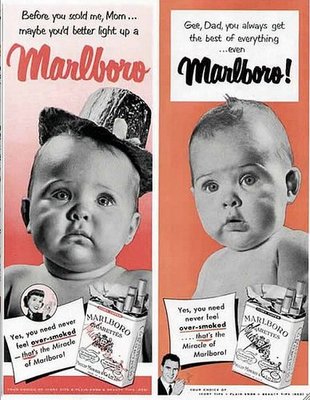
The authors of this ad use a baby to convey the message to mothers and fathers that their children are in approval of their smoking, and that you can never "over-smoke."

The creators of this advertisement suggest that using Axe will result in the attraction of all different types of women.
Wednesday, January 25, 2012
Political Cartoon Thesis
 The creators of this advertisement are suggesting that Pepsi is superior to Coca Cola in that even straws refuse to be associated with Coke.
The authors of this advertisement suggest that wearers of Nike shoes/clothing will be able to perform well.
The creators of this advertisement use pathos to appeal to the audience that users of Apple products are hip, cool, and different.
Monday, January 16, 2012
Rhetoric!
Everything I encounter on a normal day has some kind of rhetorical impact on me. Even if I'm not consciously processing it, advertisements get me thinking about products, flyers cause me to consider going to events, tweets put new ideas in my mind, and some commercials even persuade me to reexamine my values. All of this comes about with just a simple, nonchalant glance at a flyer, commercial, t shirt, or tweet. My mind captures a mental picture and unconsciously takes away an idea from the artifact. Rhetoric plays a very key role in almost all of our lives. It's very easy to go about a day without realizing even for a moment that you have been attacked by hundreds of various new ideas, thoughts, and values. Rhetoric has a huge effect on everyone's lives, whether we realize it or not!